Mastering different note taking methods is one of the most effective ways to improve academic performance.
Have you ever scored lower than your expectations in an exam and exclaimed ‘well, how do the toppers do it so easily all the time?!’ Perhaps we have an answer to that! Making decent notes was found to be the most common study habit of students who score well consistently. Especially for those who are now pursuing higher education, hastily scribbling down bits and keywords from your lecturer’s speech simply will not cut it anymore.
Effective note taking is a skill that is acquired over time with a lot of trial and error but we are here to present to you some of the best note taking methods for students along with the key benefits of using effective note-taking strategies.
Best Note Taking Methods For Students To Get Started With
As we previously mentioned, even if you have been avoiding making notes since your school days, note-taking is a skill which can be acquired, improved and perfected through practice. It does require plenty of trial and error to figure out which method works the best for you.
There exists a number of note-taking methods to choose from, but how do you decide? What is the difference between all these methods of taking notes? Settle in, we will explain all four methods.
1. The Outline Method:
Are you somebody who wants absolute structure in their notes? Then, this is the method for you! You begin by jotting down the heading of the topic at the very top of the page and keep on adding any information points that are covered by that topic right underneath the main heading in the form of bullet points.
Notes made using the outline method will look something like this:
This is a main topic
- This is a subtopic
1. This is a thought/supporting fact
2. This is a thought/supporting fact
- This is a subtopic
1. This is a thought/supporting fact
2. This is a thought/supporting fact.
This method is particularly helpful if the subject you are taking notes for is content heavy. Organizing the information with the outline method can help you study better since you only focus on the important components of the content.
The bonus of using this method is that it is immensely easy to understand and follow as there is no need for too much hard work while you take down your notes.
2. The Cornell Method:
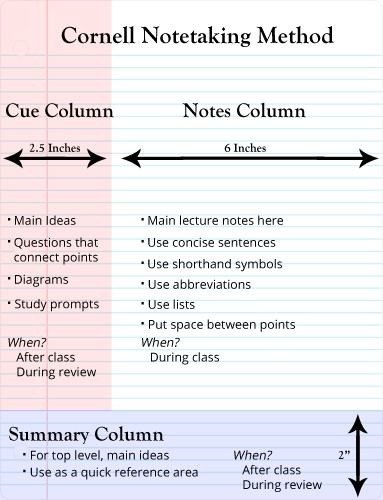
Let us talk about the Cornell method for taking notes, it is a wildly popular method of taking notes, especially amongst college students. You begin by separating your page into columns by drawing lines and marking the narrower column as the ‘cue’ column, where you place the main concept and important terminology from the content of your notes.
(Source – https://pdf.wondershare.com/mobile-app/cornell-note-taking-system.html)
As for the wider column, you mark it as the ‘outline’ column and place the descriptions/explanations of the key concepts and terminology (which have been placed in the ‘cue’ column already). Towards the bottom of the page, you may include a ‘summary’ section, where you are encouraged to quickly reiterate the concept in your own words. The Cornell method is particularly helpful because it requires you to reiterate the content of your notes at the end of your note-making session!
3. The Charting Method:
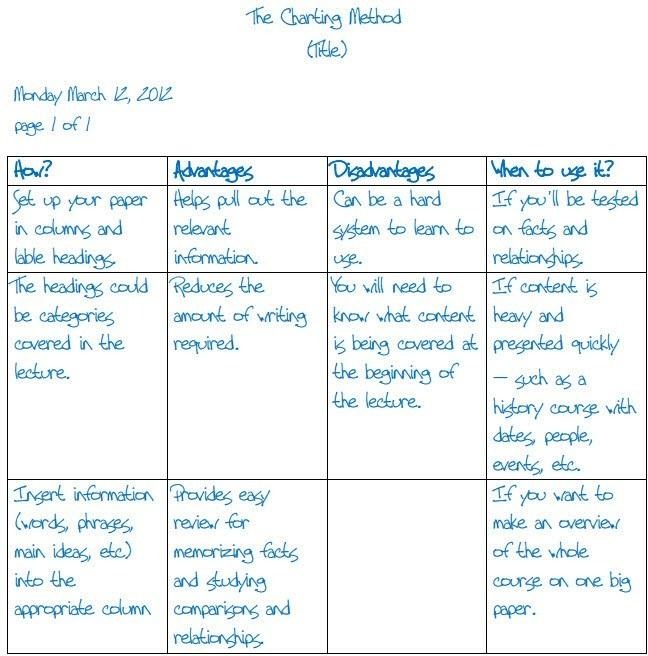
Do you remember your school textbooks depicting certain information through tables and charts? The charting method is the most thoroughly structured method of note-taking, it is a particularly helpful method when it comes to subjects like the sciences and statistics. You can organize the information in tabular form, or make a spreadsheet of the content.
(Source – https://msliewsclass.weebly.com/charting-method.html)
The advantage of using this method is that every bit of the information can be included, nothing gets cut away to ‘only focus on the key points’, which is incredibly useful for any of the STEM (Science, Technology, Engineering, and Mathematics) disciplines. It is perhaps the most effective format for memorizing loads and loads of important information but takes essentially no time when it comes to editing and condensing your notes as the test week draws closer, so you can get cracking on your notes right away!
4. The Mapping Method:
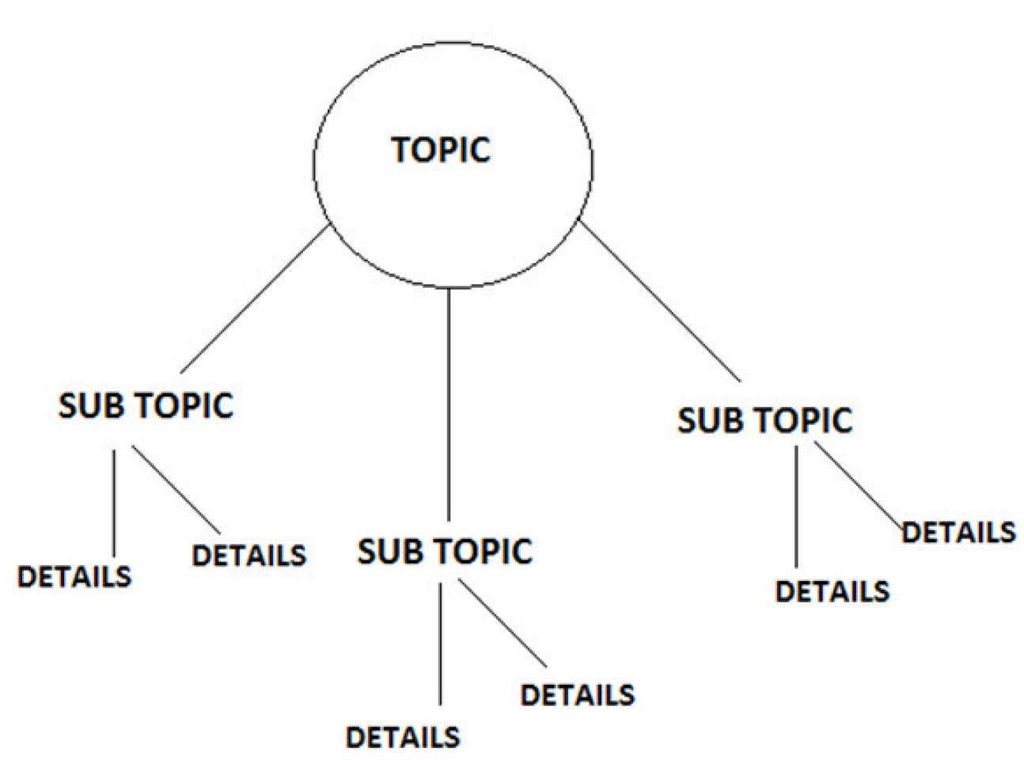
Sometimes, neatly stacking the information into sections or bullet points might simply not cut it for you and we understand that! The mapping method of taking notes allows room for all of your creativity to be unleashed. You begin by simply writing the topic of your notes. It can be at the very top of the page, or in the middle of the page and start adding the sub topics along with any other information related to that topic underneath the main topic using arrows (if you have put the topic at the top of the page), or around it (if you have put the topic in the middle of the page).
(Source – https://www.imperial.ac.uk/admin-services/library/learning-support/assignment-tips/prepare-it/notetaking/)
The best thing about using mind-maps as a method of note-making is that it allows room for mistakes. Is your professor one of those people who prefers to lecture in an unstructured manner? If yes, well, that is absolutely fine, because there is no need for any structure in mind maps as mind maps are brilliant when it comes to revision as well, because you can simply add any further important bits of information which you come across later, onto the mind maps, as long as there is space on the page, there are no rules and, of course, it is so much fun!
How Do Effective Note-Taking Methods Help?
Looking at these seemingly complex note-taking methods might get you wondering if it’s even worth spending time learning to make notes. You might recall the exams that you aced perfectly well even without making notes. So, is note making even necessary? And, how does it help you score better?
The thing about having been someone who got good grades in school without much genuine studying is that those study habits or lack thereof, simply do not work the same in higher education. Developing a habit of taking effective notes is something which will keep your grades as good as they used to be, back in the good old school days.
So, what good are all these note taking methods going to do for you? Let’s look at some of the benefits of note taking below
1. Better Concentration:
In the lecture hall, when your professor keeps going on and on about some topic that you tell yourself you will study on your own when the exam draws closer, would it not be a lot easier if you just paid some attention now?
When you get into the habit of taking notes during class, you are forced to pay close attention to the contents of the lecture, meaning that instead of resorting to passively listening to the professor and forgetting more than half of it almost immediately, you become an active listener, you pay close attention to the content being presented to you since you are trying to sift through all the ‘waffle’ or the unnecessary information in an effort to take notes which are short but precise.
2. Quicker Grasp Of The Content:
It is a given thing pretty much anywhere, that if you listen to something with enough concentration, you will most likely be able to recall it more easily than something you were not quite paying attention to.
Hence, when you listen to your lectures in class actively, it results in you retaining a better portion of the lecture which helps you to grasp the lecture content considerably easier and quicker.
3. Excellent Preparation For The Exam:
Notes taken through effective methods of note-taking make your life easier by providing an overview of each and every topic discussed in class which allows you to make connections throughout the study material and inevitably, having the content etched into your long term memory.
4. Improved Memory:
Every student experiences the same struggle where, as they learn new topics so they begin to forget the old ones unless they revise. Making notes is essential for quick revision because they prevent you from having to read through entire chapters every time; a quick glance at your notes is enough to refresh your memory. This also improves memory retention because it is much harder to remember lengthy or overly detailed information. That’s why, reviewing these concise notes helps keep your memory sharp.
Conclusion:
We have now reached the end of this article, we hope our tips and advice on note-taking and revision can be of some use to you during the upcoming exam season. Go try making a mind-map or two and see how helpful effective note-taking methods are, we are rooting for you to do well by using these, good luck!
References:
- Study looking at Mind Mapping as a Teaching Resource: https://pubmed.ncbi.nlm.nih.gov/21134197-mind-mapping-as-a-teaching-resource/?from_term=Mind-mapping&from_pos=6
- Study on the the influence of colour on Memory Performance: https://www.ncbi.nlm.nih.gov/pmc/articles/PMC3743993/
- Study examining if Spaced Learning enhances Episodic Memory by increasing Neural Pattern Similarity Across Repetitions: https://pubmed.ncbi.nlm.nih.gov/31036763-spaced-learning-enhances-episodic-memory-by-increasing-neural-pattern-similarity-across-repetitions/?from_term=Spaced+repetition&from_pos=8